Associação Portuguesa de Investigação em Cancro
Natural-inspired flavonoid derivatives show promising activity against leukemia cells
Natural-inspired flavonoid derivatives show promising activity against leukemia cells
An international team of researchers led by Patricia Rijo (Lusófona University) has recently published a study demonstrating the anticancer potential of derivatives inspired by natural products. The investigated compounds, naphthyl derivatives based on flavonoid structures, were initially developed during the PhD research of Emília Leitão, currently a researcher at Hovione FarmaCiência.
The recently published work results from an international collaboration between CBIOS – the Research Center for Biosciences and Health Technologies at Universidade Lusófona and the Universidad de Las Palmas de Gran Canaria (Spain). The study also involved the coordination of Francisco Estévez and Henoc del Rosario, who carried out a postdoctoral fellowship at CBIOS, contributing to the development of this line of research.
Authors and Affiliations:
Emília P. T. Leitãoa,*, Henoc del Rosariob,c, Inmaculada Hernándezc, Ignacio Gonzálezc, José Quintanac, Ester Saavedrac, Francisco Estévezc*, Patricia Rijob,d,e,*
aProcess Chemistry Development, HovioneFarmaCiencia S.A., Estrada do Passo do Lumiar, Campus do Lumiar, Edificio S, 1649-038 Lisboa, Portugal
bCBIOS-Lusófona University's Research Center for Biosciences and Health Technologies, 1749-024 Lisbon, Portugal
cDepartamento de Bioquímica y Biología Molecular, Fisiología, Genética e Inmunología, Instituto Universitario de Investigaciones Biomédicas y Sanitarias (IUIBS), Universidad de Las Palmas de Gran Canaria, Spain
d Instituto de Investigação do Medicamento (iMed.ULisboa), Faculdade de Farmácia, Universidade de Lisboa, 1649-003 Lisbon, Portugal
e Centro de Química Estrutural, Institute of Molecular Sciences,, Universidade de Lisboa, Campo Grande, 1749-016 Lisboa, Portugal
∗Corresponding authors
Abstract:
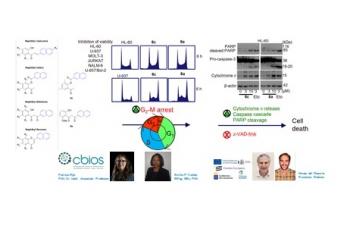
By 2030, the incidence of new cases of cancer worldwide is expected to have increased by 18.1%, with a 22% increase in mortality. Leukaemia is the most common childhood cancer, and drug resistance remains a major therapeutic challenge. Many factors contribute to drug resistance, including inhibition of apoptotic cell death. Natural product-based drugs have led to significant advances in the treatment of human cancer. Due to their polyphenol structure, flavonoids exhibit various pharmacological properties, including antitumor activities. Here we evaluated the effects of twenty compounds including naphthyl chalcones and intermediates of flavones on viability of human leukaemia cells. Seven compounds showed growth inhibition against HL-60, U-937, MOLT-3, JURKAT, NALM-6 and the overexpressing Bcl-2 protein U-937/Bcl-2. Almost all IC50 values were below 10 µM, and, for HL-60 and U937, the naphthyl ester 6c and the naphthyl diketone 8a compounds showed IC50 values that were very similar to the standard therapeutic drug etoposide. Treatment of HL-60 and U-937 with 6c and 8a caused an increase in the percentage of sub-G1 cells, G2-M cell cycle phase arrest, activation and processing of caspases, poly(ADP-ribose) polymerase cleavage and cytochrome c release from mitochondria. Moreover, cell death was partially blocked by the general inhibitor of caspases z-VAD-fmk. Interestingly, the overexpression of Bcl-2 did not prevent U-937/Bcl-2 cells from dying.
Journal: Biomedicine & Pharmacotherapy
Link: https://www.sciencedirect.com/science/article/pii/S0753332226001885?via%3Dihub